
Nobody warned me about the cold.That is the first thing I’ll say about the Free State. I climbed into the car in Johannesburg on a weekday morning, excited and under-prepared, and four and a half hours later stepped out into Maluti Mountain air that had absolutely no mercy. My colleagues from KKT (Kathorus Kgotso Tourism) thought it was hilarious. I did not, initially. But the drive itself — mountain upon mountain, canyon upon canyon rolling past the windows — warmed something deeper than my bones.
The Free State is one of South Africa’s least-visited provinces. That’s not an insult; it’s an opportunity. As a DMC, our work is to find what’s worth experiencing before everyone else does, package it honestly, and put it in front of the world. What we found in the Free State made me feel, genuinely, like we’d been sleeping on something extraordinary.
The route from Johannesburg to Golden Gate Highlands National Park takes you through terrain that doesn’t behave the way you expect. Our colleague Alan Ramushu pointed out something that stayed with me long after the trip: the flat-topped mountains you see throughout this region are not random geological formations. According to oral tradition passed down through generations, those plateaus are what remain of trees — enormous ones — that the Creator ordered his angels to cut down as punishment for the people of the land. You see those flat peaks and the story makes a strange kind of sense. Something was removed. What’s left has the dignity of what endured.
As we drew closer to Golden Gate, we noticed shallow cavities and window-like openings carved into the mountainsides. These were homes. The San people — southern Africa’s oldest known inhabitants — built their lives into the rock face of these very mountains, and understanding who they were makes the drive feel like something more than scenery.
A brief note on the San and Khoikhoi, because the distinction matters:
The San (historically called Bushmen, a term now considered derogatory) are among the world’s oldest cultures, having inhabited southern Africa for approximately 100,000 years before any other group arrived. They were hunter-gatherers — nomadic, spiritually rich, and deeply attuned to the natural world. The name “San” was actually given to them by the Khoikhoi, meaning “people different from ourselves.
“The Khoikhoi (or Khoe) arrived later, as pastoralists who kept sheep and cattle. They called themselves “Khoikhoi,” meaning “men of men” or “real people.” Unlike the San’s flat social structure, the Khoikhoi had a hierarchical society. The two groups had both conflict and exchange, eventually merging into what is collectively called the Khoisan people. Today, both cultures are critically endangered — but their presence is encoded into the landscape we were driving through.
Golden Gate Highlands National Park
South Africa has 21 national parks managed by SANParks (South African National Parks) across the country. The portfolio runs from the world-famous Kruger National Park in Limpopo and Mpumalanga, to the Kgalagadi Transfrontier Park on the Botswana border, the Garden Route National Park spanning the Eastern and Western Cape coast, Table Mountain National Park in Cape Town, Addo Elephant National Park outside Gqeberha, and many others including Augrabies Falls, Mapungubwe, Bontebok, Karoo, Marakele, and Mountain Zebra. At TD Travels, our mission is to visit every single one and report back.
Golden Gate is the only proclaimed national park within the grassland biome in South Africa. A biome, simply put, is a large ecological zone defined by its climate, plants, and animals — like a fingerprint for a particular type of environment. The grassland biome is one of the most threatened in the country; much of it has been converted to farmland or urban development. Golden Gate’s proclamation was, in part, an act of conservation for this biome before it disappeared entirely.
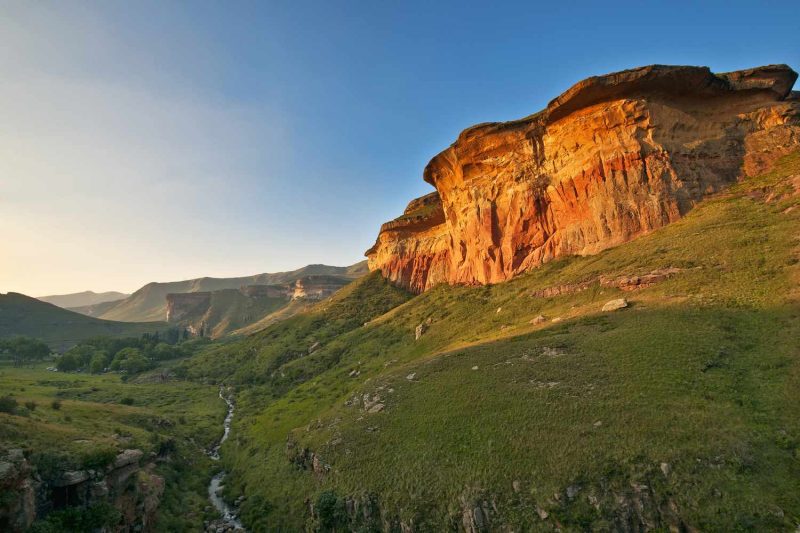
The park sits in the north-eastern Free State, tucked into the Maluti Mountains at 34,000 hectares. It gets its name from a moment in 1880, when a farmer named Dan van Reenen arrived with his family and watched the afternoon sun fall on the sandstone cliffs in a warm golden light. He bought the farm and named it accordingly. The land was later reclaimed on 13 September 1963 and expanded over the years, incorporating the former Qwaqwa National Park to reach its current size.
Entry fees for South African residents are R75 per adult — reasonable for what you get.
The day we visited, rain had swept through and the cave tour, dinosaur tour, and hiking trails were closed. We were disappointed for about five minutes. Then we got back in the car and did a two-hour self-drive through the park, stopping at every viewing point, and the disappointment dissolved completely. Valleys. Waterfalls catching light. Mountains that look painted. The park accommodation: chalets sleeping two, four, six, and eight guests, overlooks this directly, with a natural pool fed by a waterfall on the grounds. The two-sleeper rondavels are thatched, with private entrances, a mini kitchen, and a braai on the patio. For a couple wanting to disappear for a weekend, it’s nearly perfect.
The Information Centre: Where the Real Learning Happened
Before our self-drive, we stopped at the park’s information centre: a small room that I ended up spending far longer in than planned.
Rock art:
The San used rock art as a primary form of communication and spiritual record. The paint itself was made from six ingredients: blood, urine, egg white, plant sap, saliva, and fat. The ratio mattered — more blood produced a darker hue. Whether the blood came from animals or humans remains unknown. These weren’t decorations. They were records of spiritual experience, social events, and ecological knowledge.
The eland holds a central place in San symbolism. It appears across rock art sites throughout southern Africa and carries layered meaning: it’s associated with a girl’s coming of age, a boy’s first hunt, marriage ceremonies, rain-making rituals, and shamanic practice. The shaman would enter a trance state to access what the San understood as supernatural potency, and the eland was the conduit for that power. The trance itself was the mechanism; a deliberate altered state of consciousness performed for the wellbeing of the community. When you look at San rock paintings with this context, they stop being ancient graffiti and start being something closer to sacred text.
Golden Gate sits on fossil-rich ground. The Lesothosaurus was named in 1978, a genus of omnivorous ornithischian dinosaur whose name translates to “lizard from Lesotho.” It weighed roughly 40 kilograms and walked on two legs. Small, but significant.
The information board in the centre explains the type of fossil evidence found here: bone fossils and ichnites. Ichnites are trace fossils — not the creature itself, but evidence of its movement. Footprints, eggs, tracks. They can tell researchers about an animal’s gait, its speed, its body size, and whether it moved in herds. The footprints at Golden Gate confirm that millions of years ago, dinosaurs crossed this exact ground. Knowing that while standing there adds a particular weight to the experience.
Letsatsi Game Lodge: Two Nights Under a Different Sky
Both nights were spent at Letsatsi Game Lodge, about an hour’s drive from the park. The lodge carries authentic African design — natural materials, earthy tones, references to the animals of the region woven into the architecture. The mountain views don’t leave you here either; they’re waiting every morning when you open your curtains.
What I wasn’t expecting was the stargazing.
The sky in the Free State is a different thing entirely from what we see in Johannesburg. No light pollution worth mentioning. Our ranger, Benjamin, gave us an impromptu astronomy lesson on the night the zodiac was in Aries. He showed us the constellation’s arrow formation and then explained how to use it to find direction: draw two imaginary lines from the arrow and the two stars below it, trace where they’d intersect, and follow that point to the Southern Star. That’s your south.
He introduced us to Sirius, the brightest star in the night sky, and the first to appear as evening comes. It arrives while it’s still light outside, flickering with a particular intensity. Benjamin described it as the star that announces night. He’s right. Once you’ve seen it, you’ll always look for it first.
Why the Free State Deserves to Be on Your List
The province doesn’t sell itself loudly. There are no billboards counting down the kilometres to major attractions. What it has instead is depth — geological, cultural, historical, spiritual. You can drive through it in a day and feel you’ve grazed the surface of something enormous.
We couldn’t do the cave tour or the dinosaur trail because of the rain. We’re going back. That should tell you something.
For first-time visitors: the self-drive alone at Golden Gate justifies the trip. Build at least two nights into the itinerary, stay somewhere with a clear sky view, and bring warmer clothes than you think you need. The Free State will take care of the rest.
TD Travels is a boutique Destination Management Company based in Gauteng, packaging tailor-made journeys across South Africa, Zimbabwe, Botswana, and Namibia. This expedition was conducted in partnership with KKT (Kathorus Kgotso Tourism) as part of our ongoing commitment to uncovering South Africa’s overlooked provinces and presenting them honestly to the world.
For trade enquiries: bookings@tdtravels.co.za | +27 68 108 9048 | www.tdtravels.co.za
